


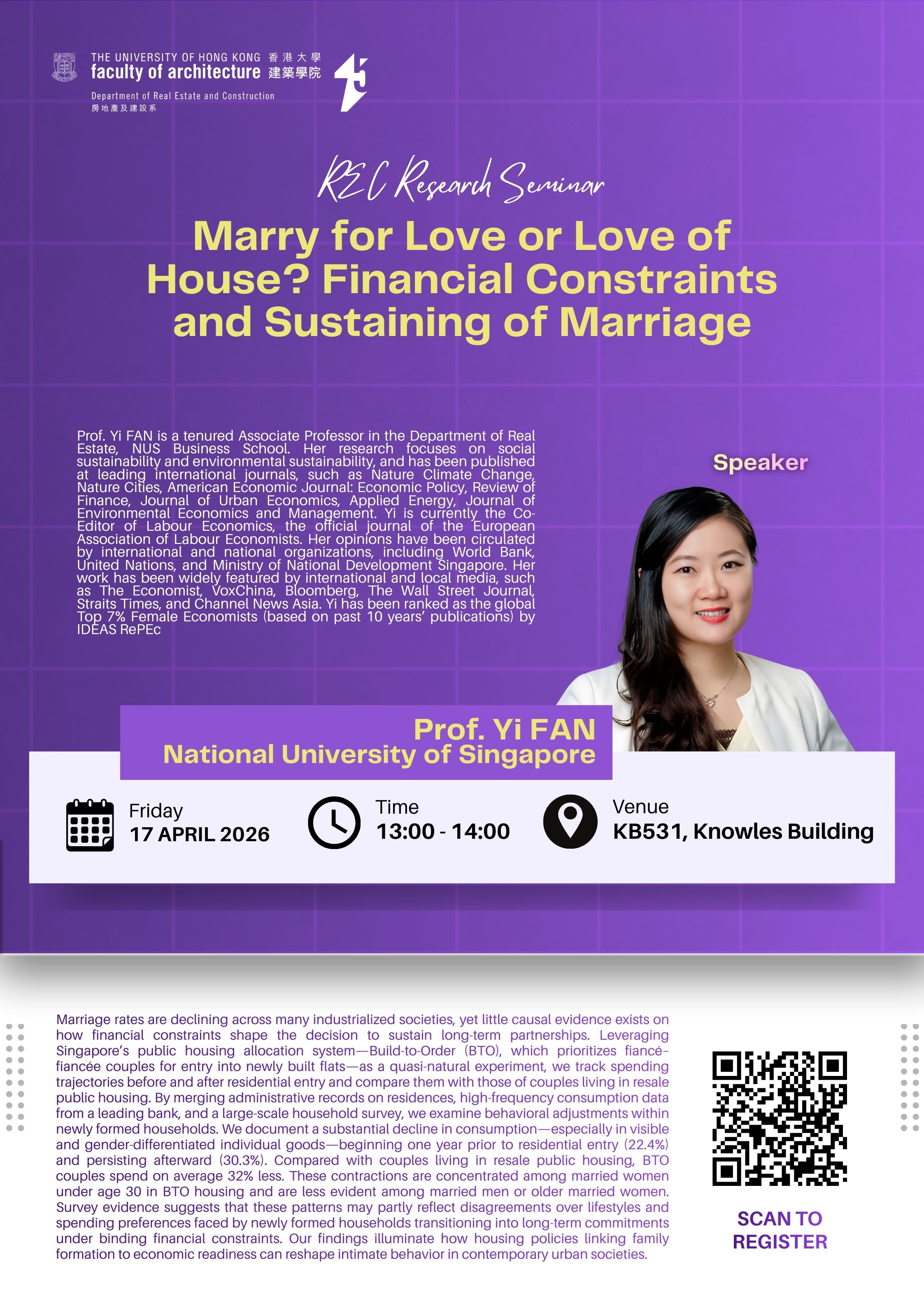
REC Research Seminar Series (Apr 17) – “Marry for Love or Love of House? Financial Constraints and Sustaining of Marriage” by Prof. Yi FAN, National University of Singapore
About the Speaker:
Prof. Yi FAN is a tenured Associate Professor in the Department of Real Estate, NUS Business School. Her research focuses on social sustainability and environmental sustainability, and has been published at leading international journals, such as Nature Climate Change, Nature Cities, American Economic Journal: Economic Policy, Review of Finance, Journal of Urban Economics, Applied Energy, Journal of Environmental Economics and Management. Yi is currently the Co-Editor of Labour Economics, the official journal of the European Association of Labour Economists. Her opinions have been circulated by international and national organizations, including World Bank, United Nations, and Ministry of National Development Singapore. Her work has been widely featured by international and local media, such as The Economist, VoxChina, Bloomberg, The Wall Street Journal, Straits Times, and Channel News Asia. Yi has been ranked as the global Top 7% Female Economists (based on past 10 years’ publications) by IDEAS RePEc.
Abstract:
Marriage rates are declining across many industrialized societies, yet little causal evidence exists on how financial constraints shape the decision to sustain long-term partnerships. Leveraging Singapore’s public housing allocation system—Build-to-Order (BTO), which prioritizes fiancé–fiancée couples for entry into newly built flats—as a quasi-natural experiment, we track spending trajectories before and after residential entry and compare them with those of couples living in resale public housing. By merging administrative records on residences, high-frequency consumption data from a leading bank, and a large-scale household survey, we examine behavioral adjustments within newly formed households. We document a substantial decline in consumption—especially in visible and gender-differentiated individual goods—beginning one year prior to residential entry (22.4%) and persisting afterward (30.3%). Compared with couples living in resale public housing, BTO couples spend on average 32% less. These contractions are concentrated among married women under age 30 in BTO housing and are less evident among married men or older married women. Survey evidence suggests that these patterns may partly reflect disagreements over lifestyles and spending preferences faced by newly formed households transitioning into long-term commitments under binding financial constraints. Our findings illuminate how housing policies linking family formation to economic readiness can reshape intimate behavior in contemporary urban societies.
Organizer

Department of Real Estate and Construction


Comments are closed