


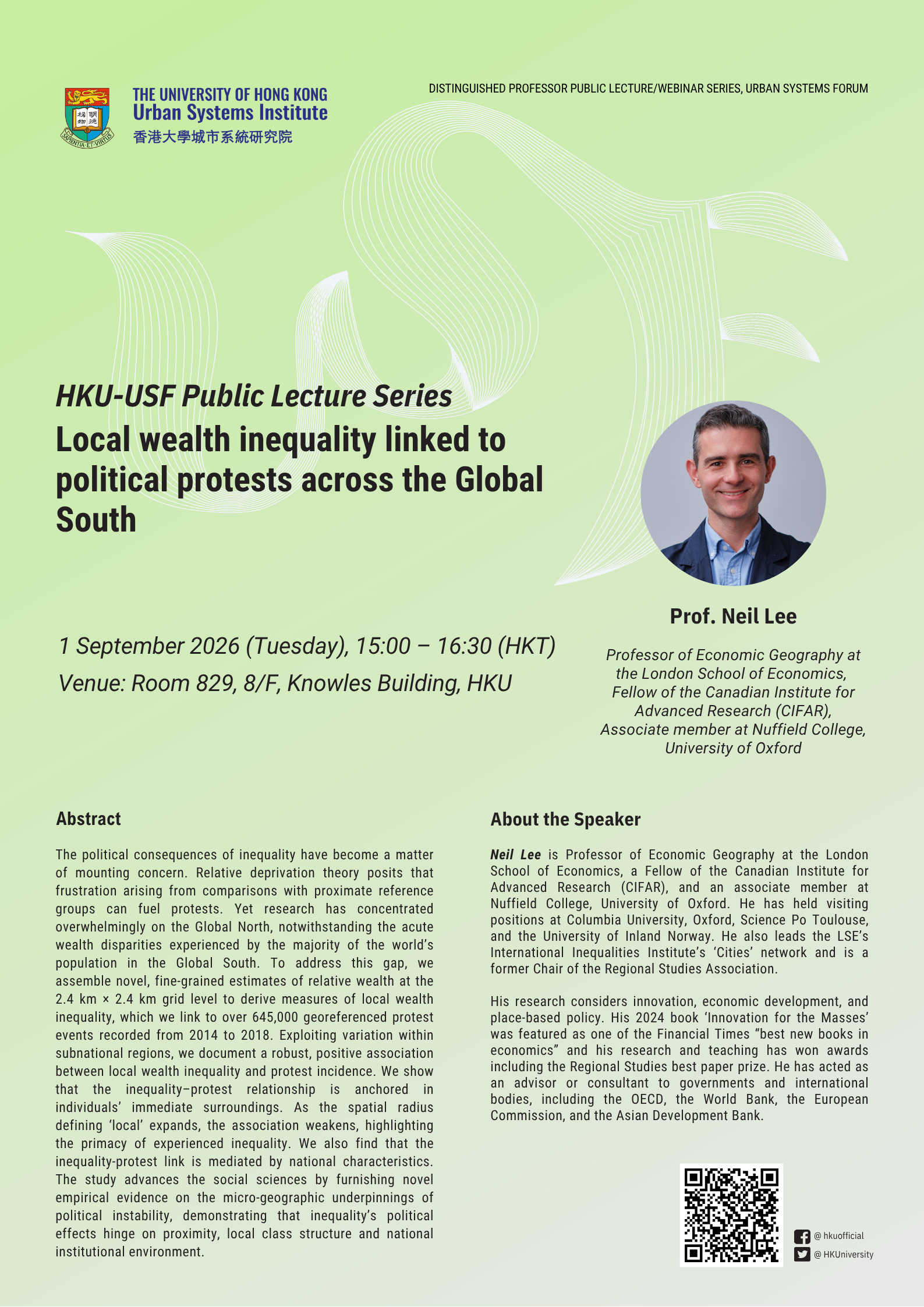
Research seminar (Sept 1)- “Local Wealth Inequality Linked to Political Protests across the Global South”
About the talk:
The political consequences of inequality have become a matter of mounting concern. Relative deprivation theory posits that frustration arising from comparisons with proximate reference groups can fuel protests. Yet research has concentrated overwhelmingly on the Global North, notwithstanding the acute wealth disparities experienced by the majority of the world’s population in the Global South. To address this gap, we assemble novel, fine-grained estimates of relative wealth at the 2.4 km × 2.4 km grid level to derive measures of local wealth inequality, which we link to over 645,000 georeferenced protest events recorded from 2014 to 2018. Exploiting variation within subnational regions, we document a robust, positive association between local wealth inequality and protest incidence. We show that the inequality–protest relationship is anchored in individuals’ immediate surroundings. As the spatial radius defining ‘local’ expands, the association weakens, highlighting the primacy of experienced inequality. We also find that the inequality-protest link is mediated by national characteristics. The study advances the social sciences by furnishing novel empirical evidence on the micro-geographic underpinnings of political instability, demonstrating that inequality’s political effects hinge on proximity, local class structure and national institutional environment.
About the speaker:
Neil Lee is Professor of Economic Geography at the London School of Economics, a Fellow of the Canadian Institute for Advanced Research (CIFAR), and an associate member at Nuffield College, University of Oxford. He has held visiting positions at Columbia University, Oxford, Science Po Toulouse, and the University of Inland Norway. He also leads the LSE’s International Inequalities Institute’s ‘Cities’ network and is a former Chair of the Regional Studies Association.
His research considers innovation, economic development, and place-based policy. His 2024 book ‘Innovation for the Masses’ was featured as one of the Financial Times “best new books in economics” and his research and teaching has won awards including the Regional Studies best paper prize. He has acted as an advisor or consultant to governments and international bodies, including the OECD, the World Bank, the European Commission, and the Asian Development Bank.
Organizer

Comments are closed